
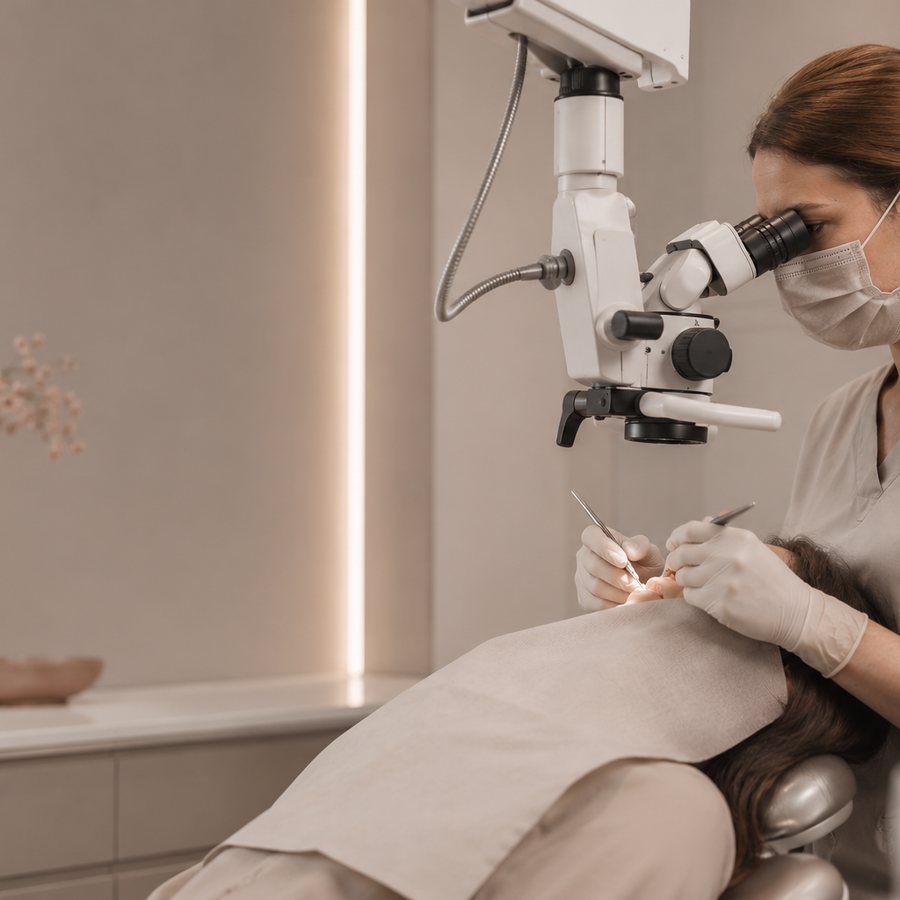
An inflamed tooth rarely has to be extracted today. Under the operating microscope, the fine canal system inside the tooth becomes visible and can be treated precisely – often the tooth is preserved for many years.
03 — Tooth preservation
Why under the microscope
The root canal system of a tooth is branched, curved and often narrower than a tenth of a millimetre. With the naked eye, side canals and additional entrances are easily missed – and that is exactly where bacteria can remain and cause trouble later.
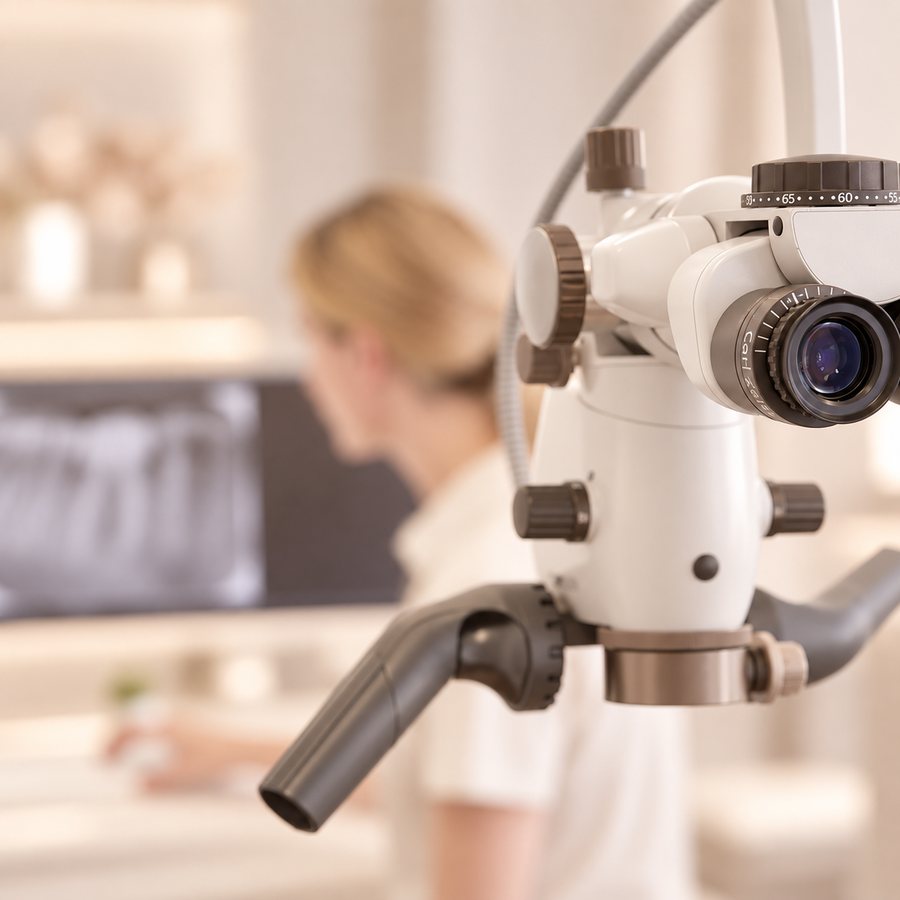
Under the operating microscope we work at up to 21-fold magnification and with good illumination. This makes it possible to locate the canals completely, to preserve healthy tooth substance and to assess difficult situations: separated instruments, calcified canals or an already treated root.
How the treatment works
We begin by anaesthetising the tooth and isolating it with a rubber dam – so no saliva enters the canal system and no rinsing solution reaches your mouth. Then we open the tooth, locate the canals and determine their length electronically.
The canals are then prepared with fine, machine-guided instruments and rinsed thoroughly. This rinsing is the actual core of the treatment: it reaches areas no instrument touches. Afterwards the canal system is sealed and the tooth restored.
Depending on the findings, one session may be enough; sometimes two are needed. We take the time the tooth requires – a root canal treatment done under time pressure lasts less often. All treatment rooms are air-conditioned, which makes longer appointments noticeably easier to sit through.
Afterwards: the restoration matters too
A root-treated tooth is more brittle than an untreated one, because it has lost substance and moisture. Whether a filling is sufficient or a crown makes sense depends on how much healthy wall remains. We discuss this before treatment begins, so you can see the whole path including the costs.
Statutory insurers cover root canal treatment under certain conditions. Services beyond that – such as treatment under the microscope – are usually private. You receive a written plan in advance.
Should a tooth prove impossible to save despite careful treatment, we say so openly and discuss the alternatives. A hopeless attempt at preservation helps no one.
Frequently asked
What patients ask us about this
Does a root canal treatment hurt?
As a rule, root canal treatment today is virtually painless. The tooth is carefully anaesthetised beforehand, so you normally feel no pain during treatment.
With severely inflamed teeth, anaesthesia can occasionally be more demanding. In that case we can add further anaesthetic and adapt the treatment individually.
Afterwards the tooth may feel sensitive to pressure or biting for a few days. These symptoms usually subside on their own.
How many sessions are needed?
In most cases we can complete the treatment in two sessions. If the nerve is severely inflamed or the inflammation has already spread to the bone, further sessions may be necessary.
Does my insurance cover treatment under the microscope?
Statutory health insurers generally do not cover the additional cost of using a treatment microscope; for patients with statutory insurance it is usually charged privately.
For privately insured patients and those with supplementary dental insurance, reimbursement depends on the tariff. We recommend asking your insurer in advance.
Talk to us
Whether this treatment is right for you is something we clarify in a personal conversation. Book online or give us a call.